Phone:
(701)814-6992
Physical address:
6296 Donnelly Plaza
Ratkeville, Bahamas.

Phone:
(701)814-6992
Physical address:
6296 Donnelly Plaza
Ratkeville, Bahamas.
In Mexico, the management of organic waste has become one of the main environmental and productive challenges for the agro-industrial sector. Every year, thousands of tons of waste from agricultural and industrial processes are discarded without proper treatment, generating negative impacts on the environment, soils, and water quality.
However, organic waste should not be seen as waste. In reality, it represents a strategic opportunity to strengthen sustainable agriculture, improve soil fertility, and move toward circular economy models. When these residues are properly managed through processes such as industrial composting, they can be transformed into high-value inputs for the field.
This approach is especially relevant in industries such as the tequila industry, where agave residues can be converted into organic compost that returns nutrients to the soil and closes the production cycle.
Organic waste is biodegradable material of plant or animal origin that can naturally decompose through the action of microorganisms. Among the most common are:
Unlike inorganic waste, organic waste has the potential to reintegrate into the natural cycle if properly processed. The problem arises when there is no responsible management, as its accumulation can generate methane emissions, soil contamination, and damage to water bodies.
For this reason, the proper transformation of organic waste is not only an environmental necessity, but also an economic opportunity.
The circular economy proposes changing the way we understand waste. Instead of a linear “produce–use–discard” model, it suggests a system where organic waste returns to the production cycle as raw material.
In agroindustry, this means that residues such as agave bagasse can undergo controlled industrial composting processes. Through biological action and proper technical management, these materials are transformed into organic compost rich in essential nutrients for the soil.
This model:
The transformation of organic waste into compost is not just an ecological alternative, it is a smart strategy for sustainable development.
Industrial composting is a controlled process where organic waste is subjected to specific conditions of moisture, temperature, and aeration to accelerate its decomposition.
During this process:
The result is an organic compost that improves soil structure, increases water retention capacity, and provides slow-release nutrients.
In the case of agave residues, composting makes it possible to transform large volumes of organic waste into a sustainable agricultural solution that can be used in various crops.
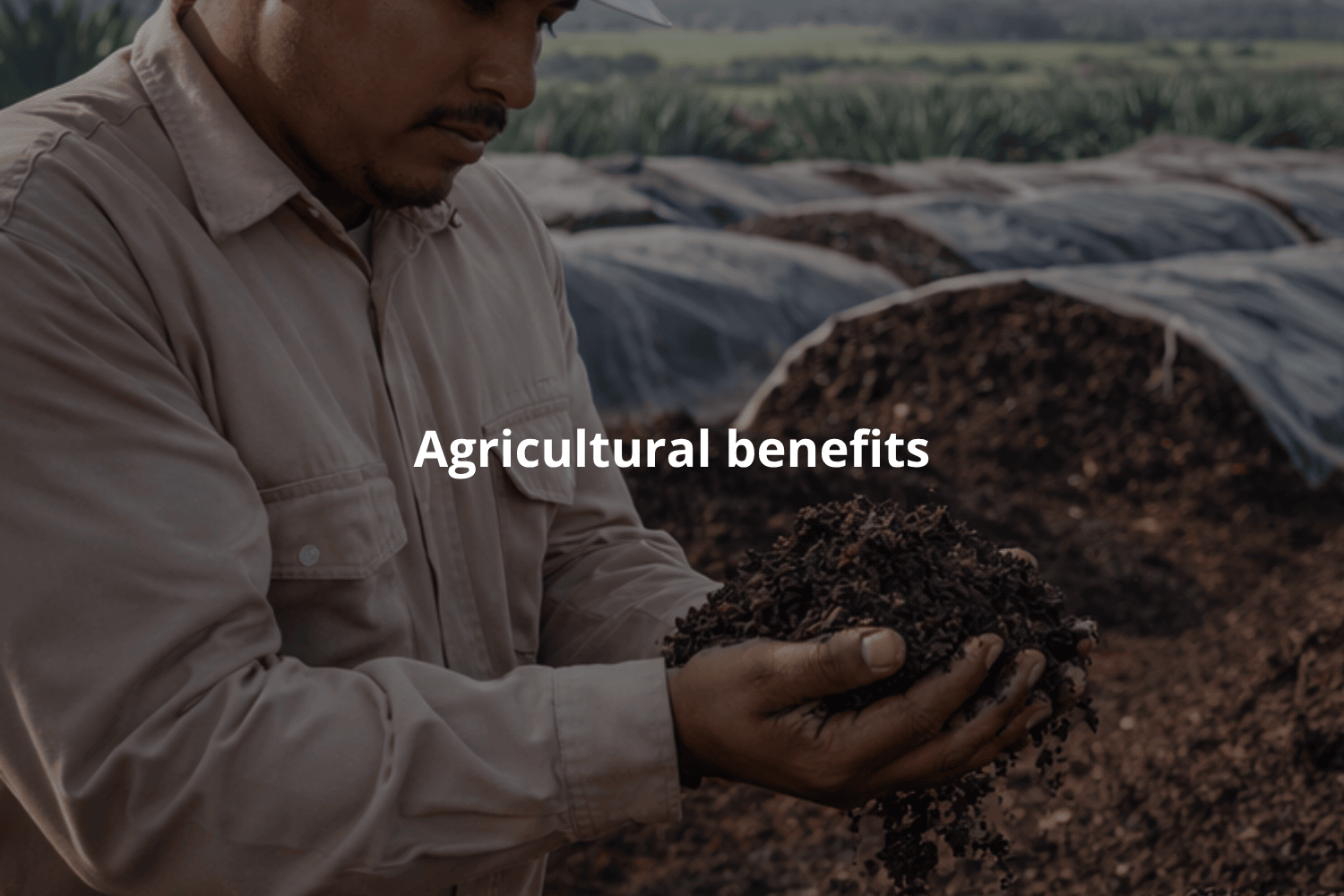
Transforming organic waste into compost offers concrete benefits for producers:
Mexico is a global leader in tequila production, generating a significant volume of agave waste. This organic waste, far from being a problem, represents an opportunity to strengthen the sector’s sustainability.
Agave bagasse, when properly treated, can be transformed into high-value agricultural compost. This process:
Proper management of industrial organic waste positions companies as actors committed to sustainable development.
Today, companies that properly manage their organic waste not only comply with environmental regulations, but also strengthen their reputation and competitiveness.
Integrating industrial composting solutions allows:
Responsible waste management is no longer an option, it is a strategic necessity.
Organic waste should not be seen as an inevitable problem of agricultural and industrial production. On the contrary, it represents an opportunity to promote sustainability, improve soil fertility, and strengthen the circular economy in Mexico.
When agave residues and other agro-industrial byproducts are transformed through controlled composting processes, they become real solutions for the field. This regenerative vision makes it possible to close production cycles, reduce environmental impact, and return nutrients to the soil.
In this context, Sue Tequilana plays a fundamental role by converting organic waste from the tequila industry into organic compost with high agricultural value. Through responsible processes and specialized technology, the company demonstrates that it is possible to transform waste into opportunities, integrating sustainability, innovation, and environmental commitment.
The future of Mexican agriculture depends on more conscious production models. And the intelligent use of organic waste is, without a doubt, one of the keys to achieving it.